Choosing the wrong statistical test can invalidate your entire thesis. One of the most common decisions dissertation students face is whether to use a t-test or ANOVA to analyze their data. Make the wrong choice, and your committee will send you back to redo your analysis.
The good news is that the decision is straightforward once you understand the key difference between these tests. This guide shows you exactly when to use t-tests versus ANOVA in Excel, with a simple decision framework, comparison table, and real dissertation examples.
Quick Answer: The 5-Second Decision Rule
The fastest way to choose between t-test and ANOVA is to count your groups:
Comparing 2 groups? → Use a t-test
Comparing 3 or more groups? → Use ANOVA
That is the fundamental distinction. A t-test compares means between exactly two groups. ANOVA (Analysis of Variance) compares means across three or more groups simultaneously.
Decision Flowchart
Here is a visual decision framework to help you choose:

Figure 1: Decision flowchart for choosing between t-test and ANOVA based on number of groups and study design
This flowchart handles 90% of dissertation scenarios. The rest of this guide explains the reasoning behind these decisions and provides detailed examples.
What is a T-Test?
A t-test is a statistical hypothesis test that determines whether there is a significant difference between the means of two groups. It answers the question: "Are these two group averages different enough that the difference is unlikely due to random chance?"
T-tests are commonly used in thesis research when you need to compare two conditions, treatments, or populations.
Types of T-Tests
1. Independent Samples T-Test
Compares means between two separate, unrelated groups. Use this when different subjects are in each group.
Example: Comparing exam scores between students who studied with Method A versus Method B.
2. Paired Samples T-Test
Compares means for the same group measured at two different times or under two different conditions. Use this when the same subjects appear in both measurements.
Example: Comparing employee productivity before and after training.
3. One-Sample T-Test
Compares the mean of a single group against a known population mean or theoretical value.
Example: Testing whether your university's average GPA differs from the national average of 3.0.
When to Use T-Tests in Your Thesis
Use a t-test when your research design involves:
- Exactly two groups to compare
- A continuous dependent variable (measured on interval or ratio scale)
- Independent observations (each data point is independent)
- Normally distributed data (or large sample sizes where Central Limit Theorem applies)
What is ANOVA?
ANOVA (Analysis of Variance) is a statistical test that determines whether there are significant differences between the means of three or more independent groups. Despite its name focusing on variance, ANOVA compares group means by analyzing the variation within groups versus variation between groups.
ANOVA answers the question: "Is at least one group mean significantly different from the others?"
Types of ANOVA
1. One-Way ANOVA
Tests the effect of one independent variable (factor) with three or more levels on a continuous dependent variable.
Example: Comparing student performance across four different teaching methods.
2. Two-Way ANOVA
Tests the effects of two independent variables simultaneously, plus their interaction effect.
Example: Comparing weight loss across three diet types and two exercise levels (testing diet effect, exercise effect, and diet-exercise interaction).
When to Use ANOVA in Your Thesis
Use ANOVA when your research design involves:
- Three or more groups to compare
- One or two categorical independent variables
- A continuous dependent variable
- Independent observations across all groups
- Normally distributed data with equal variances across groups
The Post-Hoc Testing Requirement
If ANOVA shows a significant result, you cannot stop there. ANOVA only tells you that at least one group differs, not which specific groups differ. You must conduct post-hoc tests (such as Tukey HSD, Bonferroni, or Scheffé) to identify which pairs of groups are significantly different.
This is a critical step that many students forget, leading to incomplete analyses.
T-Test vs ANOVA: Side-by-Side Comparison
| Feature | T-Test | ANOVA |
|---|---|---|
| Number of Groups | Exactly 2 groups | 3 or more groups |
| Primary Purpose | Compare two means | Compare multiple means simultaneously |
| Test Statistic | t-value (follows t-distribution) | F-value (follows F-distribution) |
| Type I Error Risk | 5% (α = 0.05) for single comparison | Maintains 5% across all groups |
| Post-Hoc Tests | Not needed (only 2 groups) | Required if significant result |
| Excel Function | Data Analysis → t-Test (3 types) | Data Analysis → ANOVA: Single Factor |
| Common Use Cases | Before-after studies, two treatments, control vs experimental | Multiple treatments, multiple groups, complex experimental designs |
| Complexity | Simpler calculation and interpretation | More complex, requires follow-up tests |
Table 1: Comparison of t-test and ANOVA features for statistical analysis
Decision Framework: Which Test Should YOU Use?
Let me walk you through four real dissertation scenarios to show you exactly how to make this decision.
Scenario 1: Psychology Thesis (T-Test)
Research Question: Does cognitive behavioral therapy reduce anxiety more than medication alone?
Design: 60 patients randomly assigned to two groups (CBT or medication). Anxiety measured after 8 weeks using a standardized scale.
Decision: Use an Independent Samples T-Test
Why: Two separate groups (CBT vs medication), different patients in each group, one continuous outcome (anxiety score).
Scenario 2: Education Thesis (ANOVA)
Research Question: Which teaching method produces the highest student achievement: lecture-based, flipped classroom, project-based, or blended learning?
Design: 120 students randomly assigned to four teaching methods. Final exam scores compared across all four groups.
Decision: Use One-Way ANOVA
Why: Four groups to compare (more than 2), one independent variable (teaching method), continuous outcome (exam score).
Follow-up: If ANOVA shows significance, use Tukey HSD post-hoc test to determine which specific teaching methods differ from each other.
Scenario 3: Business Thesis (Paired T-Test)
Research Question: Does implementing a new customer service training program improve employee satisfaction scores?
Design: 40 employees complete satisfaction surveys before and after the training program.
Decision: Use a Paired T-Test
Why: Same employees measured twice (before and after), two time points, continuous outcome (satisfaction score). The observations are paired because each employee serves as their own control.
Scenario 4: Health Sciences Thesis (Two-Way ANOVA)
Research Question: How do diet type and exercise frequency affect weight loss? Is there an interaction between diet and exercise?
Design: 180 participants assigned to one of three diets (low-carb, low-fat, Mediterranean) and one of two exercise levels (moderate or intensive). Weight loss measured after 12 weeks.
Decision: Use Two-Way ANOVA
Why: Two independent variables (diet type with 3 levels, exercise with 2 levels), continuous outcome (weight loss), need to test both main effects and interaction effect.
Why Not Just Run Multiple T-Tests?
When you have three or more groups, you might wonder: "Why not just compare them pairwise with multiple t-tests?"
The answer is Type I error inflation (also called alpha inflation or family-wise error).
The Mathematical Problem
Each t-test has a 5% chance of finding a false positive (Type I error, α = 0.05). This means there is a 5% probability of concluding groups differ when they actually do not.
When you run multiple t-tests, these error probabilities accumulate:
3 groups require 3 t-tests (A vs B, A vs C, B vs C): Family-wise error = 1 - (1 - 0.05)³ = 0.143 or 14.3% error rate
4 groups require 6 t-tests: Family-wise error = 1 - (1 - 0.05)⁶ = 0.265 or 26.5% error rate
5 groups require 10 t-tests: Family-wise error = 1 - (1 - 0.05)¹⁰ = 0.401 or 40.1% error rate
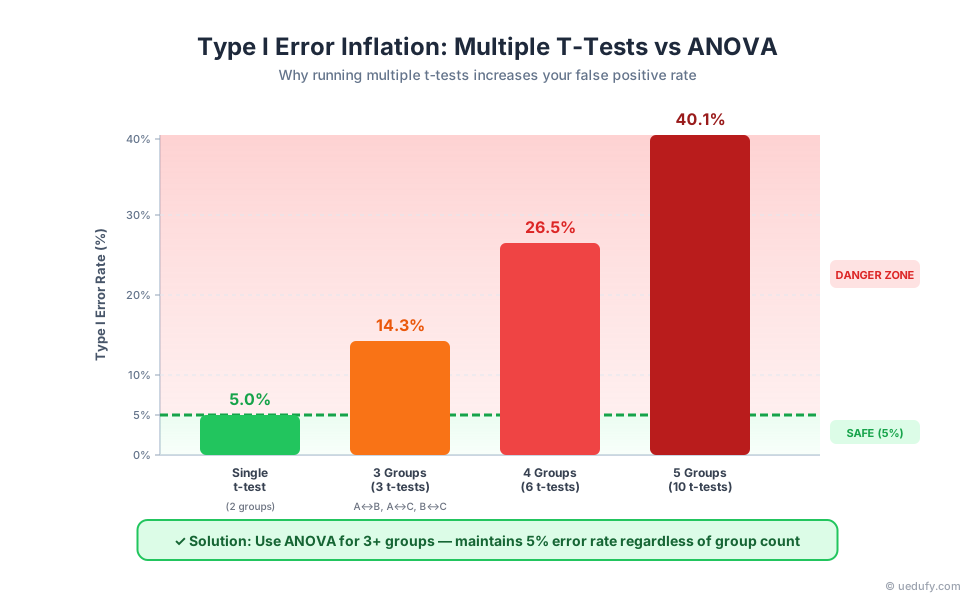
Figure 2: Type I error inflation when running multiple t-tests versus using ANOVA
The ANOVA Solution
ANOVA tests all groups simultaneously in a single test, maintaining the 5% Type I error rate regardless of how many groups you compare. This is why ANOVA is the statistically correct choice for three or more groups.
If ANOVA finds significance, you then use post-hoc tests (which include error corrections like Bonferroni or Tukey) to identify specific group differences while controlling the overall error rate.
How to Run Both Tests in Excel
Excel provides both t-tests and ANOVA through the Data Analysis ToolPak. Here is how to access each test.
Setting Up the Data Analysis ToolPak
If you have not enabled the Data Analysis ToolPak:
- Click File → Options → Add-ins
- Select "Excel Add-ins" from the Manage dropdown
- Click Go
- Check "Analysis ToolPak" and click OK
For detailed instructions, see our guide on how to add Data Analysis in Excel.
Running a T-Test in Excel
- Click Data tab → Data Analysis
- Select the appropriate t-test type:
- t-Test: Two-Sample Assuming Equal Variances (most common)
- t-Test: Paired Two Sample for Means (for before-after designs)
- t-Test: Two-Sample Assuming Unequal Variances (if variances differ significantly)
- Enter Variable 1 Range and Variable 2 Range
- Set Alpha (typically 0.05)
- Choose Output Range
- Click OK
For a complete walkthrough with screenshots, see our T-Test in Excel Complete Guide.
Running ANOVA in Excel
- Click Data tab → Data Analysis
- Select ANOVA: Single Factor
- Enter Input Range (all groups in adjacent columns)
- Choose "Columns" or "Rows" depending on data layout
- Set Alpha (typically 0.05)
- Choose Output Range
- Click OK
Excel outputs an ANOVA table with F-statistic and p-value. If p < 0.05, at least one group differs significantly from the others.
Note: Excel does not provide built-in post-hoc tests. You will need to use statistical software like SPSS or R for post-hoc comparisons, or manually calculate them.
5 Common Mistakes When Choosing Tests
1. Using T-Test for Three or More Groups
Mistake: Running t-tests to compare three teaching methods by doing Method A vs B, A vs C, and B vs C.
Why it is wrong: This inflates Type I error from 5% to 14.3%. You risk finding false differences.
Correct approach: Use one-way ANOVA to compare all three methods simultaneously.
2. Ignoring Whether Data is Paired
Mistake: Using an independent t-test for before-after measurements on the same subjects.
Why it is wrong: Independent t-tests assume separate, unrelated groups. Before-after data on the same subjects is paired (related), which reduces variability and increases statistical power.
Correct approach: Use a paired t-test when the same subjects are measured twice.
3. Forgetting Post-Hoc Tests After ANOVA
Mistake: Finding a significant ANOVA result (p < 0.05) and concluding "the groups are different" without identifying which specific groups differ.
Why it is wrong: ANOVA only tells you that at least one group differs. It does not tell you which pairs are different. Your committee will ask, "Which groups are significantly different from each other?"
Correct approach: After a significant ANOVA, conduct post-hoc tests (Tukey HSD, Bonferroni, or Scheffé) to identify specific group differences.
4. Not Checking Test Assumptions
Mistake: Running t-tests or ANOVA without verifying that data meets required assumptions (normality, equal variances, independence).
Why it is wrong: Violating assumptions can lead to incorrect p-values and invalid conclusions. Your results may not be trustworthy.
Correct approach: Check assumptions before testing. For normality, use histograms or Shapiro-Wilk test. For equal variances, use Levene's test. If assumptions are violated, consider non-parametric alternatives (Mann-Whitney U instead of t-test, Kruskal-Wallis instead of ANOVA).
5. Choosing Tests Based on Results
Mistake: Running both t-test and ANOVA on the same data, then reporting whichever gives the "better" result.
Why it is wrong: This is p-hacking and constitutes research misconduct. Your test choice must be determined by your research design before looking at results.
Correct approach: Choose your statistical test based on your study design (number of groups, data type, independence) before collecting data. Document your analysis plan in your Methods section.
Frequently Asked Questions
Next Steps
You now have a clear framework for choosing between t-tests and ANOVA for your thesis research. The decision comes down to counting your groups: two groups require a t-test, three or more groups require ANOVA.
Here is what to do next:
If you need to run a t-test in Excel, see our complete guide on T-Test in Excel: Complete Guide with step-by-step instructions for all three types of t-tests.
If you need to run ANOVA in Excel, see our step-by-step guide How to Calculate One-Way ANOVA in Excel for the complete process with screenshots, assumptions testing, effect size calculation, and APA reporting guidelines.
If you are analyzing survey data, start with our comprehensive guide How to Analyze Survey Data in Excel: Complete Guide to understand the full workflow from data cleaning through hypothesis testing.
Remember: choose your statistical test based on your research design before collecting data. Document your decision in your Methods section, check your assumptions, and if ANOVA shows significance, always conduct post-hoc tests to identify specific group differences.